Climate scientists have created an ecology of computational models that describe the interdependent components of the Earth system1. These models are driven by, and produce, vast quantities of data: reconstructions of greenhouse gas emissions reaching back to the Industrial Revolution2; volumetric simulations of the atmosphere, land and oceans; and future climate scenarios over the next century3. Although the enormous complexity of human interactions with planetary systems is captured in detail in the geographies of this data, public-facing analysis often takes the form of more digestible headline statements4 and global trends.
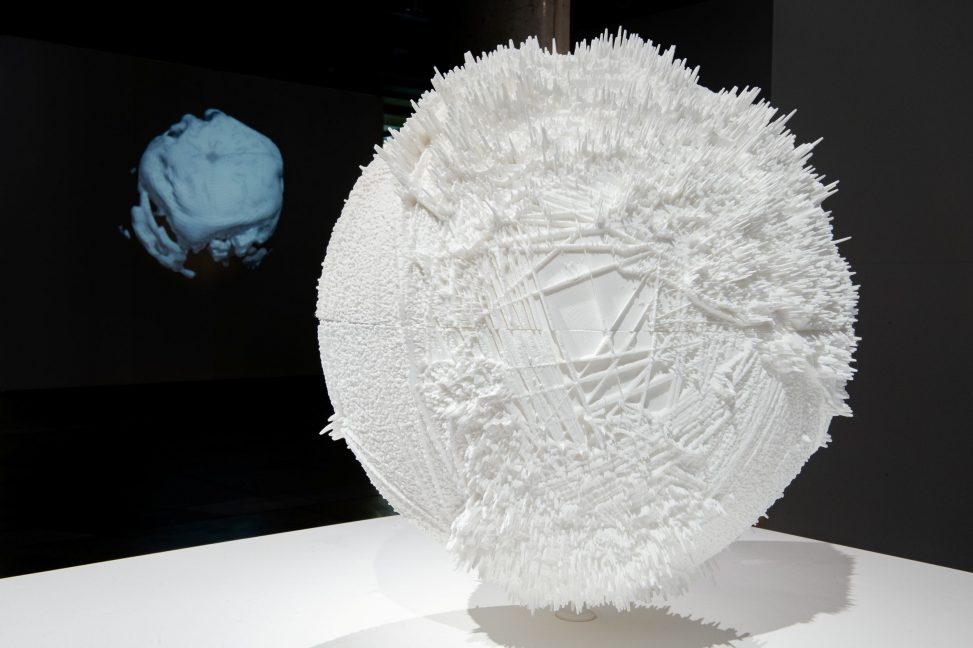
The works of Planetary Assemblages explore how the growth of the global fossil fuel economy has taken material form in the creation of the infrastructures that surround us: networks that interlink mineral and fossil deposits, extraction operations, transport routes, power plants and our expanding cities5. These formations are inscribed in the models’ gridded data, which we have made tangible as 3D-printed topographies, tactile sculptures and animated globes. Emissions become terrain, rising in ridges along the courses of pipelines, shipping lanes and flight paths, and as archipelagos at sites of industrialisation. In the atmosphere, contours of CO₂ concentration are concretised into solid plumes enveloping the planet6.
As well as charting the expansion of infrastructures and their emissions, the works show how the data carries the imprint of power relations, technological and economic transformations, and shifts in the centres of development. That history runs from the growth of the coal trade in eighteenth-century Britain7, through two centuries of intense industrialisation across Europe8 and North America9, to the movement of manufacturing towards China and Southeast Asia since the 1970s.
The project comprises three bodies of work. Carbon Topographies maps the geographies of CO₂ emissions since the 1970s, Carbon Chronicles traces their deeper history from the eighteenth century, and Atmospheric Engines gives physical form to the fluxes of CO₂ in the atmosphere. The first two draw on the anthropogenic emissions data that drives climate models; the third on the volumetric data the models produce.
Planetary Assemblages brings together work from Materialising Data: Embodying Climate Change, an interdisciplinary project between Central Saint Martins and the British Antarctic Survey, funded by the Arts and Humanities Research Council.
The work was produced in collaboration with Tom Corby and Jonathan Mackenzie. Further documentation can be seen at the Atmospheric Research Collective site.
Notes
- Paul N. Edwards, A Vast Machine: Computer Models, Climate Data, and the Politics of Global Warming, First paperback edition, Infrastructures Series (The MIT Press, 2013). ↩
- CEDS, ‘A Community Earth-Atmosphere Data System (CEDS) for Historical Surface Fluxes’, Pacific Northwest National Laboratory (PNNL), 2020, https://www.pnnl.gov/projects/ceds. ↩
- WCRP, ‘Coupled Model Intercomparison Project, Phase 6 (CMIP6)’, WCRP – World Climate Research Programme, 2020, https://wcrp-cmip.org/cmip-phases/cmip6/. ↩
- IPCC, ‘AR6 Synthesis Report: Summary for Policymakers Headline Statements’, Intergovernmental Panel on Climate Change (IPCC), 2023, https://www.ipcc.ch/report/ar6/syr/resources/spm-headline-statements/. ↩
- EDGAR, ‘EDGAR Global Greenhouse Gas Emissions, v5.0’, EDGAR – Emissions Database for Global Atmospheric Research, 2020, https://edgar.jrc.ec.europa.eu/dataset_ghg50. ↩
- NOAA, ‘CarbonTracker CT2019B’, NOAA Global Monitoring Laboratory, 2020, https://gml.noaa.gov/ccgg/carbontracker/CT2019B/. ↩
- Michael W. Flinn and David Stoker, The History of the British Coal Industry. Volume II. 1700–1830: The Industrial Revolution (Clarendon Press; Oxford University Press, 1984). ↩
- Astrid Kander et al., Power to the People: Energy in Europe over the Last Five Centuries, The Princeton Economic History of the Western World (Princeton University Press, 2013). ↩
- Christopher F. Jones, Routes of Power: Energy and Modern America, First Harvard University Press edition (Harvard University Press, 2016). ↩
Exhibitions and Publications
Exhibitions
- The Air We Share. Curated by Neli Wagner and Nele-Hendrikje Lehmann. Deutsches Hygiene-Museum, Dresden, Germany, 9 November 2024–10 August 2025.
- Climate Engines. Curated by Daphne Dragona and Jussi Parikka. LABoral Art and Industrial Creation Centre, Gijón, Spain, 6 October 2023–18 May 2024.
- Planetary Assemblages. Lethaby Gallery, Central St Martins, London, UK, 5–30 April 2022.
- Weather Engines. Curated by Daphne Dragona and Jussi Parikka. Onassis Stegi, Athens, Greece, 1 April–15 May 2022.
- Little Earths. COP26, Glasgow, UK, 31 October–12 November 2021.
Publications
- Corby, Tom, Gavin Baily, Jonathan Mackenzie, et al. ‘Political Atmospherics: Climate Visualisations at the Manifest Data Lab’. Journal of Visual Art Practice 22, no. 1 (2023): 1–7. https://doi.org/10.1080/14702029.2022.2151192.
- Corby, Tom, Gavin Baily, Jonathan Mackenzie, et al. ‘The Data Imaginaries of Climate Art: The Manifest Data Project’. Leonardo 55, no. 2 (2022): 125–29. https://doi.org/10.1162/leon_a_02136.
- Joler, Vladan, Kate Crawford, and Bani Brusadin. Freeport. Anatomía de una caja negra / Freeport. Anatomies of a Black Box. Matadero Madrid, 2021. https://issuu.com/mataderomadrid/docs/mec_vol2-freeport.